

Information concerning the start of the school year for our 2IB-students.
Information concerning the start of the school year.
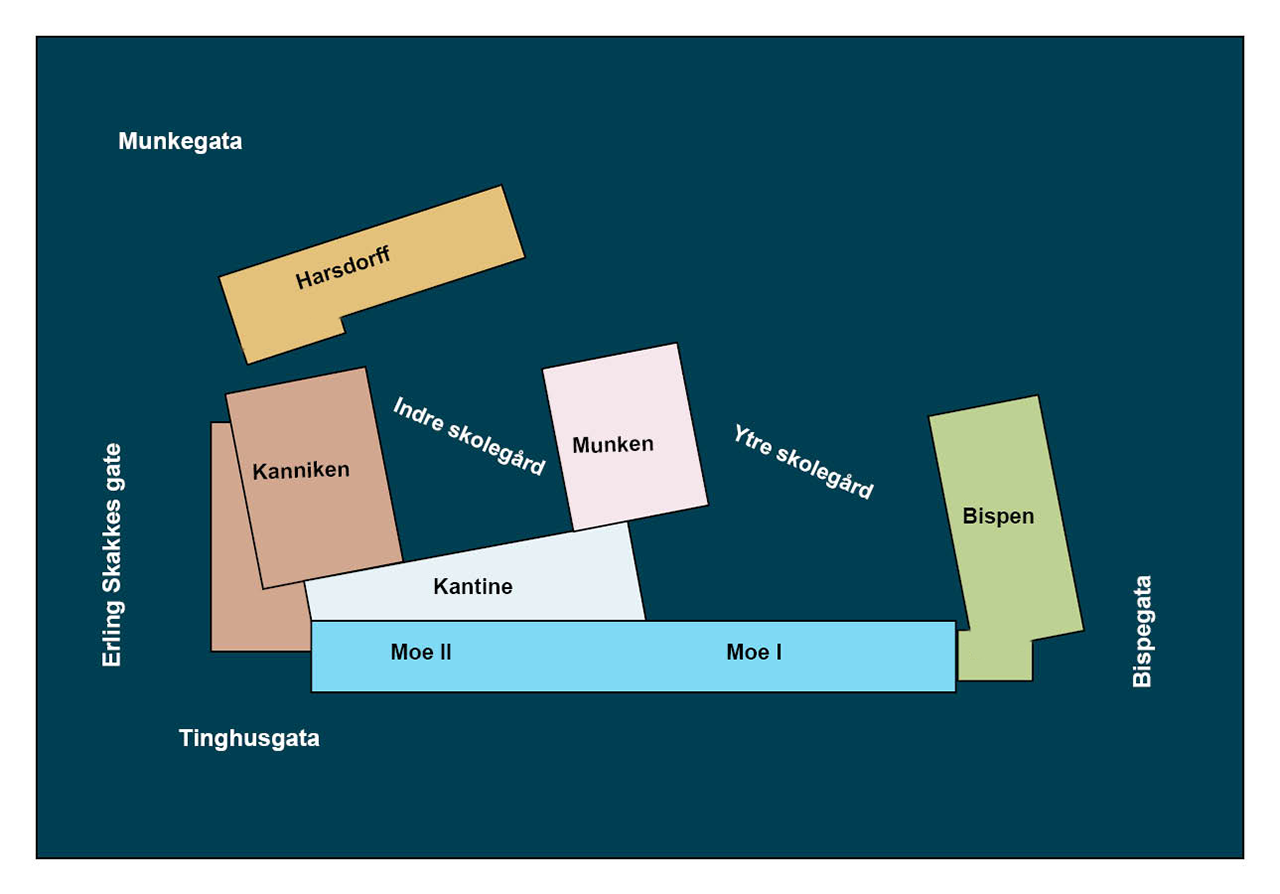
You will find the canteen attached to the central building ‘Kanniken’ most easily by using the north-western entrance at the intersection of Erling Skakkes gate and Tinghusgata.
Laptop: Students will need a laptop. You can bring your own or apply for a student computer from the county. See information (only in Norwegian)
Other equipment: Students must bring equipment such as pens, pencils, and notebooks when classes start.
Students will also need a Graphic Display Calculator for IB Mathematics. You should confer with your Mathematics teacher before acquiring one, as it must be an approved model for IB Examinations.
Trondheim Katedralskole has recently been under major reconstruction which lasted for two years. During this time, most of the teaching and school facilities were using temporary locales elsewhere in the city. We now look forward to our second year of school after moving back to our main facilities.
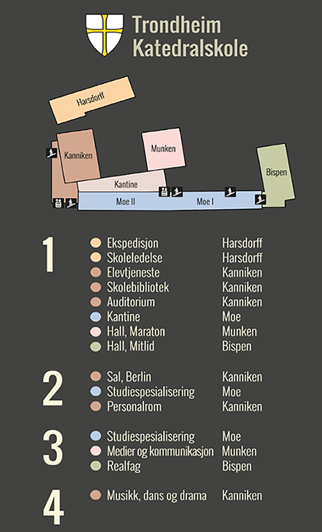
The Harsdorff building, in use from 1787, is the oldest building still in use by Trondheim Katedralskole. It houses the Senior Leadership team, the Head and Deputy Head of school, as well as the school’s expedition and several teacher offices. The building has a fully protected status and has not been part of the reconstruction effort. It also houses Gamle Festsal, which is jointly in use by Katedralskolen and DKNVS, the Royal Norwegian Society of Sciences and Letters.
Moe I and Moe II are original school buildings, in use from 1925 and 1938. The buildings primarily house classrooms and teacher offices. The Moe-buildings are also protected to some degree, and their exterior and hallways remain original. The classrooms, offices and facilities housed here have still been significantly upgraded during the reconstruction.
Munken is a brand-new building and represents the most significant expansion of the school in recent years. It houses a sports hall, Maraton, as well as the facilities for our Media and Communication department.
Bispen is another brand-new building, which replaces the now deconstructed ‘B-building’. It houses the Science department and laboratories of the school, as well as the sports hall Mitlid. The school’s southern entrance lies here, facing Bispegata. Its entrance hall is named after the artist Hannah Ryggen and houses the famous tapestry ‘Jeg risser ditt navn, Lauritz Sand’, which was gifted to the school by the artist after her stay in the Harsdorff building during the 1960s.
Kanniken is the name for what was formerly the ‘Aula building’. The exterior is largely preserved though with some extensions, but its interior is almost fully remade. It houses the facilities for our Music department, the school’s library, the auditorium, the student service, the student council’s office as well as the great hall Berlin (‘Bær-lin’), named after Johan Daniel and Johan Henrich Berlin, two important figures in the history of our school and city. The school’s northern entrance is also located here.
The school’s canteen occupies the space between Kanniken, Munken and the Moe-buildings. The IT service is also located here. A small space is left open between the canteen area and the wall of the Moe-buildings due to their protected status. It will not be generally accessible but will house various art installations commissioned by the school.
The passageway between Kanniken and the Harsdorff-building is open to the public and connects the city centre and Nidaros Cathedral by a walkway that leads through the inner and outer schoolyard. The cathedral itself lies directly opposite the street from the schoolyards southern exit.
For enquiries, please contact